
Introduction
Even after nearly 20 years, Dan Ariely’s book on behavioral economics—Predictably Irrational—remains a classic. Perhaps no other activity better illustrates predictably irrational behavior than casino gaming. I recently attended a dinner for top players at a major casino resort and spoke with the punter seated to my right regarding her beliefs around casino games. I asked this player, an avid roulette enthusiast, what she would bet on if five red outcomes occurred in a row. She responded: “I know it shouldn’t matter, but black feels overdue.” Her response—to bet against the trend—revealed two key insights: First, the patron understood the random and independent nature of the game. Second, had I posed this question to an Asian patron, the answer would likely have been to bet on the trend rather than against it.
At Differential, we have been refining a set of models to understand and predict how a player will bet and wager (see the definition above) given the prevailing context. While there are many potential applications for these models, including personalizing games, the most obvious use is identifying when a player is acting unusually. If a player exhibits odd behavior and is preternaturally lucky, this warrants investigation. We can further correlate the DNA of a patron’s play patterns or deviations from the expected to known scams. For instance, a Chinese patron playing Baccarat who encounters four consecutive banker outcomes will bet on banker more than 80% of the time. If, instead, this patron bets on tie and wins, that is unusual but not necessarily suspicious. However, specific patterns, especially improbable ones, warrant a deeper investigation.
The following analysis will be organized along two dimensions: betting and average wager amount. The average wager refers to the monetary value the player is putting at risk, while the bet is the outcome on which she is placing her wager. For instance, a player in baccarat might wager $100 on the next game outcome being ‘Player,’ and if successful, she will double her money. In this analysis, we will distinguish between base bets, which have a low house edge, and propositional bets, which can have a double-digit house advantage.
What is normal betting behavior?
Game preferences
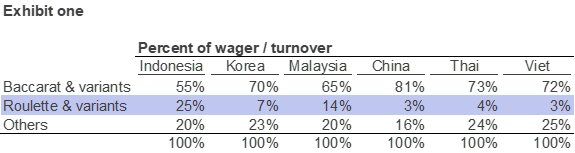
Perhaps unsurprisingly, game preferences varied markedly, largely along cultural lines. In the US, for instance, blackjack reigns supreme, and players are at least nominally skilled, while blackjack is an afterthought in Macau, where few players adhere to even basic strategy. We see cultural biases around the world and online. Exhibit one below charts turnover volume by game type and ethnicity for an online operator:
Side bet action
Preconceptions and cultural beliefs significantly shape betting behavior, often manifesting distinctly along ethnic lines. We have observed that betting behavior remains relatively consistent especially when compared to the volatility in wagering activity. Side-bet activity displays notable variation across ethnic groups. Exhibit Two, drawn from an Asian online operator, illustrates this point, showing that while on avg ~5% of turnover is placed on proposition bets, this figure can reach up to 11% in certain markets
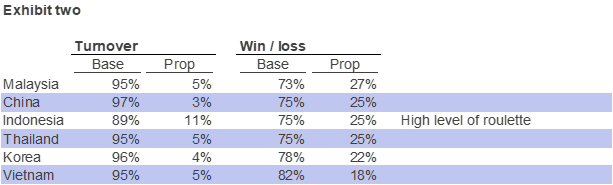
Within markets, side-bet action sometimes diverge. For instance, more mature Japanese players tend to bet conservatively, while younger Japanese players punting through an online channel and playing lower stakes tend to take side-bets more aggressively. Regardless, cultural background is strong predictor of side-bet participation.
Within our bet tracking datasets, we expected patrons who had a lower win rate during the first half of the trip to take more side bets during the latter part of her trip. We also hypothesized that players who had a fortuitous start would grow more conservative. However, we did not find that starting win rate has a material impact on bet choice during latter stages, indicating that player preference trumps risk, at least as it relates to bet choice.
Trends: the signpost of within a shoe
What is the common thread joining popular Asian games like Sic Bo and Baccarat with that stalwart of Western casinos, roulette? All of these games are trend-oriented. The majority of players react to these trends, although there are some subtle and even marked ways in which certain players deviate from the trend. For example, in the scenario of four consecutive banker outcomes, most Chinese players persist in betting on this trend, irrespective of their win rate or the occasion, such as Chinese New Year. Exhibit Three provides an example of the most powerful trends in the game of Baccarat and what percent of Chinese versus Southeast Asian players bet with this trend.
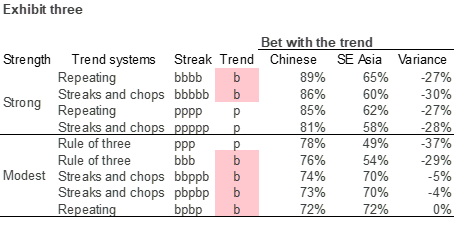
In addition to betting behavior varying along ethnicity, there are more subtle variations in betting styles. For instance, allegiance to trends varies depending on the surrounding players, and older or larger players are more likely to have idiosyncratic betting systems.
Implications
Due to these consistent biases, we can predict player betting preferences with remarkable accuracy even before the wager is placed. In fact, by knowing the trends and some basic features of a player, we can predict an existing player’s next bet with approximately 85% accuracy. Even for new players, we can predict their next bet with 70% to 80% accuracy, depending on the situation and the player’s ethnicity.
How a player varies the value of her wagers
Long before the proliferation of smart tables and iGaming, and when slot data was session-based, crawling within SAS protocol packets, we wondered how players evaluated the risk-reward trade-off at the heart of the industry. As young analysts, we excitedly read papers on the emerging psychology of risk, sometimes referred to as behavioral economics. Prospect theory, loss aversion, framing effects, sunshine bias—all great ideas central to behavioral economics, rooted in clever but still theoretical primary research.
Over the last five years, with the proliferation of bet-level transactions, we can see that while betting choices are more static wager value varies considerably. In analyzing bet tracking databases, two themes have emerged. First, we can develop models that accurately predict how a player will change her wager. This accuracy stems from the fact that players tend to alter her wagers in consistent ways. This consistent behavior often correlates with a player’s prevailing win/loss during the trip or shoe. Given a player’s prevailing win / loss she typically either grows more risk adverse or risk seeking; a behavior predicted by behavioral economics in a framework called prospect theory. For example, see Exhibit Four below, which plots whether a player increases her bet based on the winning or losing.
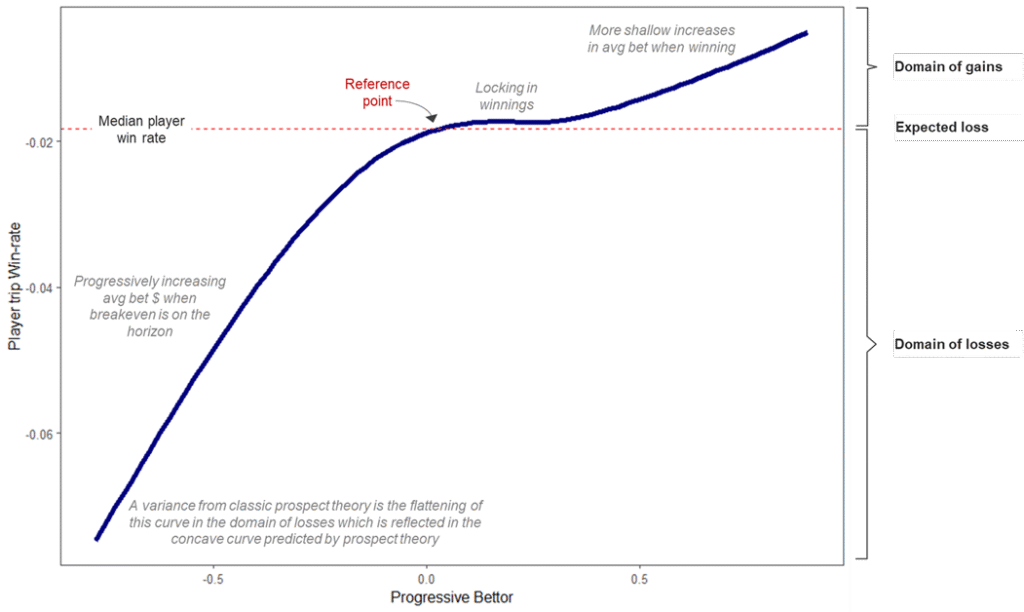
Regarding the above, the “progressive bettor” is an index that describes whether a patron progressively increases her wager during a trip. A higher ‘progressive bettor’ index score indicates that the patron increases her wagers during the trip or takes on more risk. From the plot above, we can observe that players who are losing to the house tend to seek more risk, while this behavior significantly flattens when the player is ahead of expectations. In the terminology of prospect theory, the inflection point at the start of this flattening is called the “reference point” and aligns with the median expected loss percentage. Players again increase their average wager when beating the house, but these increases are less sharp, indicating that players become risk-averse to lock in winnings.
How is all of this useful?
Firstly, understanding normal play behavior allows us to identify when people behave unusually, and we can do this at scale. With this approach, we can identify the most likely abusive players, detect collusion, and even spot chip-dumping or money laundering. Once we exonerate a player, we can use these preferences to personalize games and promotions for that specific player.